Your Cart is Empty

Hard but brittle. Soft but tough. It sounds like a contradiction, but it’s not. It’s gemology.
You’ve probably heard that diamond is the hardest gemstone in the world. True. But that doesn’t mean it’s unbreakable. There’s an old saying among gem cutters: a jade can’t scratch a diamond, but a jade can break a diamond. That’s the perfect way to explain the difference between hardness and toughness.
Both matter when you’re choosing engagement rings or any jewelry you wear daily.
Often, when we’re considering a gemstone's durability, we’re talking in the language of Mohs scale. This scale is an indicator of a gemstone’s hardness. An image of diamond so hard it’s impossible to shatter immediately comes to mind.
But this isn’t what Mr. Mohs meant when he said diamond is the hardest mineral on earth. On top of that, a gemstone’s toughness is just as important, and toughness is a totally different thing from hardness.
So how is a gemstone's hardness different from toughness? And what does it mean when a jeweler tells you a gemstone is hard, but brittle?
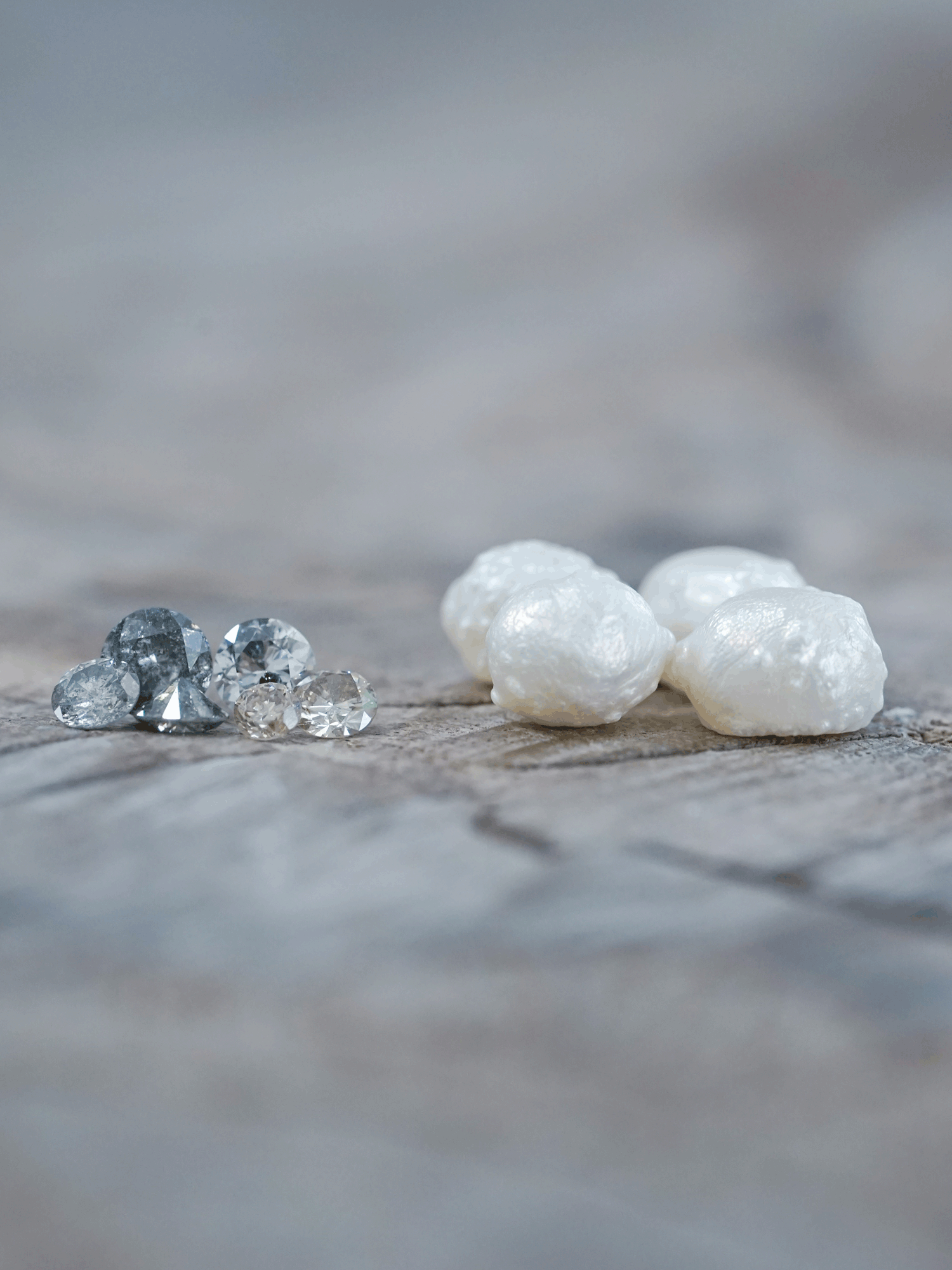
Gemstone hardness shows how resistant a stone is to scratches. It’s measured on the Mohs hardness scale, created by German mineralogist Friedrich Mohs in 1812. He scratched minerals against one another to see which one left a mark, ranking them from 1 to 10.
Talc is the softest at 1.
Diamond sits proudly at 10.
Everything else falls somewhere in between: quartz, sapphire, ruby, emerald, tourmaline.
When a jeweler says a gemstone is hard, they mean it resists scratching. It doesn’t mean it can’t break. Even dust particles floating in the air can scratch softer stones, because quartz dust ranks 7 on the Mohs scale.
Whenever you’re putting on a jacket or putting your hand on the pocket, you’re ever so slightly scratching the gemstone. Over time, scratches can build and turn your gemstone dull. Dust acts like invisible sandpaper.
That’s why your aquamarine jewelry might lose some polish if you wear it daily without care.
Diamonds can scratch sapphires. Sapphires can scratch garnets. Garnets can scratch quartz. But nothing scratches a diamond except another diamond.
So when you ask what gemstone is hardest, diamond always wins. Sapphire and ruby follow close behind at 9 on the Mohs scale.
But the Mohs scale isn’t linear. Diamond isn’t just a little harder than corundum (the mineral family of sapphire and ruby), it’s about four times harder. It's like comparing a kitchen knife to a laser cutter. Both are sharp, but one’s on another level.
Rated on scale 1-10 with 10 being the hardest
Hardness determines how easily a gemstone’s surface gets scratched, which affects how long it stays shiny. Here’s how hardness matters in daily wear and care of your jewelry:
Think of 7 as the neutral number here
Stones harder than 7 (like sapphire, spinel or diamond) are great choices for engagement rings and everyday jewelry.
Softer stones still deserve love, they just last longer in earrings or necklaces, where they’re safer from knocks and friction. If you do want a soft gemstone in a ring, consider it as a side stone instead of center stone, to minimize the visibility of fine scratches.
Store harder stones like diamonds separately so they don’t scratch others. Even within the same jewelry box, hierarchy rules apply, and diamond always wins the fight.
(opposite = brittle)
Hardness measures resistance to scratches. Toughness or tenacity measures resistance to breaking. It’s a gemstone’s ability to handle physical impact without cracking or chipping.
This all comes down to crystal structure. Some gemstones have perfect cleavage, meaning their atomic bonds line up neatly like bricks. Beautiful, but risky. Hit them at the right angle and they’ll split cleanly in two. Think of a tree or a piece of meat. Cutting against the grain will be tougher than cutting alongside the grain.
Diamond is the hardest gemstone but not the toughest. It has perfect cleavage, so it can chip with one wrong knock. Jade, on the other hand, is the toughest gemstone known to humankind. Its fibrous and tightly woven structure gives it incredible strength. That’s why jade carvings and bangles often outlast generations, while a diamond can still chip if it catches the edge of a countertop.
If you’ve ever wondered why jade is so strong, this is why. Jadeite and nephrite both rank around 6 to 7 on the Mohs hardness scale, but their toughness is exceptional. That’s why jade was used for tools, weapons and ceremonial art long before it became jewelry.
When considering a gemstone’s design, think about its toughness and how you’ll protect the gemstone, especially if it’s thinly sliced or has narrow, pointy sides. Consider also how and where you’re planning to wear it.

Rated poor, fair, good, excellent and exceptional
When designing jewelry, toughness matters as much as color or clarity. What gemstone hardness and toughness means for your jewelry’s wear and care:
Brittle stones like opal, moonstone or topaz do better in a protective bezel setting than a prong setting, especially if you’re wearing them everyday. Bezel setting generally gives the greatest protection for your ring.
Tough stones like sapphire or ruby can handle more open settings, letting in more light.
Think about the relationship between the setting and the stone cut. If you’re choosing a hexagonal cut, even for a diamond, having a claw on each corner can protect it from being chipped (because remember: diamond is prone to chipping!), a small design choice that saves heartbreak later.
Choose prong setting wisely. Yes, we love how much a prong setting can let lights through, but understand the flip side as well. Consider a basket prong (low rise, but with a lot of metal securing the gemstone) or wire basket prong (higher rise, but with thinner wire support).
Earrings and necklaces are safe homes for fragile gemstones like pearls and turquoise. Rings face more impact, so reserve them for stones with good or excellent toughness.
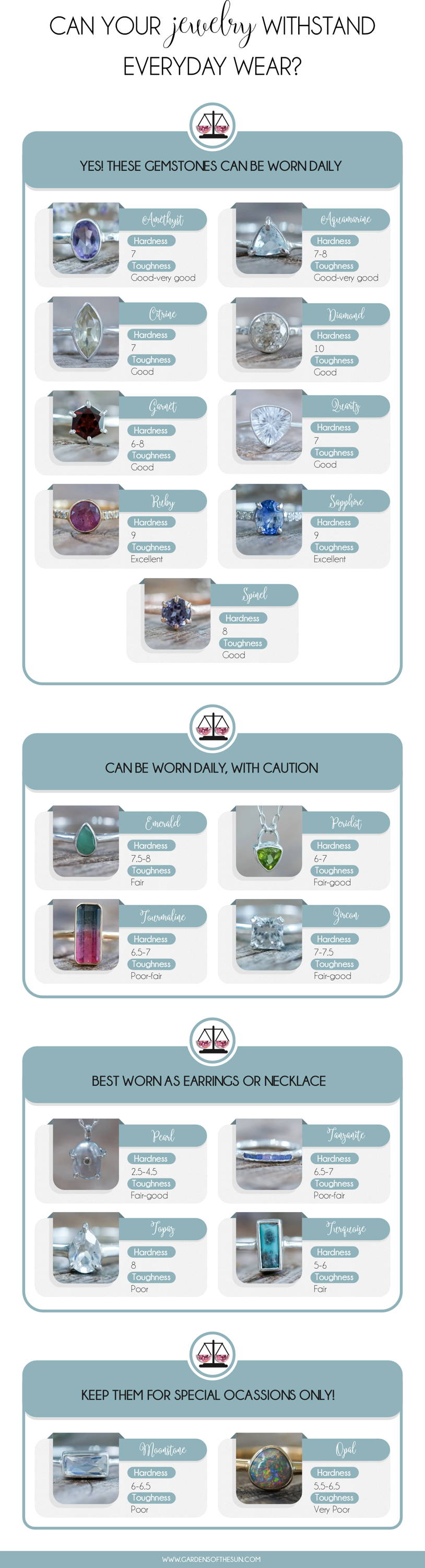
Now, let’s combine both factors and look at how the gemstones rank in terms of everyday wearability if you want to wear your jewelry daily. Choose gemstones that score well in both hardness and toughness.
Your jewelry is meant to be loved, but the right choice helps it last longer.
I’d say hardness and toughness are the first two things to take into account when designing your jewelry.
Factoring these into your design can go a long way. Because when you start thinking about its care before making a purchase, your engagement ring or gemstone jewelry can keep on shining for a long time.


